
Check the venue before trusting a Melbourne pokies listing
Location results and search snippets can suggest availability without confirming a venue’s machines, hours, safeguards or payment options.
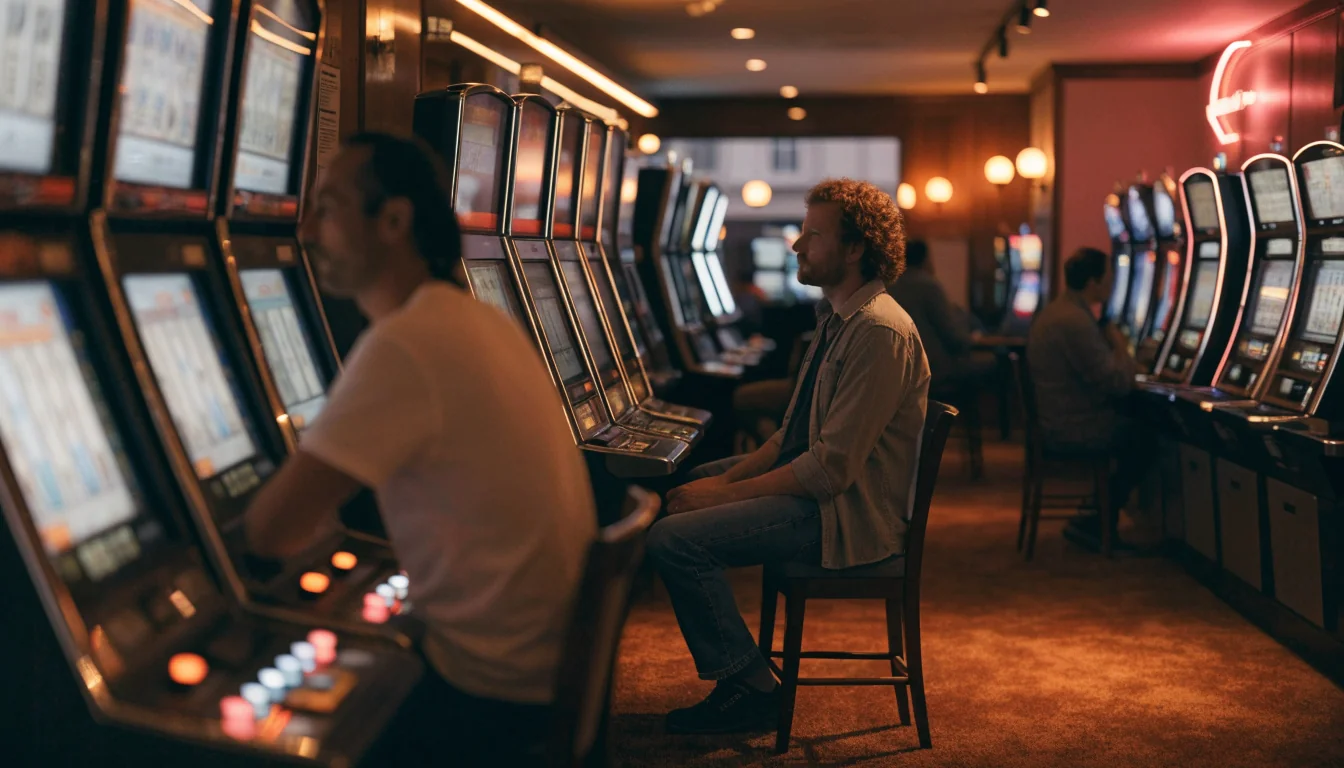
Pokies Near Melbourne Airport: Location Is Not a Venue Guarantee
A request for pokies near Melbourne Airport is primarily a location question. It does not establish that a gaming venue operates inside the airport, that a particular venue is nearby, or that any listed venue has pokies. The words identify an area of interest; they are not evidence about what is available there.
The same distinction applies when the reference point is Melbourne Central, Port Melbourne or the Melbourne CBD. A result can appear relevant because its address, map position or description is associated with the named area. That relationship alone does not confirm the venue’s facilities. “Near” also has no fixed boundary: a result may be useful for one trip and impractical for another, depending on the starting point and route.
Separate the reference point from the destination
Location-based listings can blur several different places into one result. An airport, a nearby locality, a transport connection and a venue address are not interchangeable. A listing associated with Melbourne Airport may refer to an address in the surrounding area rather than premises within the airport itself. Likewise, a result described as being near Melbourne Central may be outside the centre or may use the landmark simply to orient visitors.

The address is therefore more informative than the broad area label. Check whether the result gives a complete street address and whether that address belongs to the venue named. A map pin can help assess where the address sits in relation to the landmark, but the pin does not verify what is inside the premises. If a listing supplies only a neighbourhood label or a broad map area, it supports a weaker location claim than a clearly identified address.
This matters when the destination is not the only relevant point. Someone travelling from the airport may need a different location from someone already in central Melbourne. A venue can be geographically close to one reference point while being inconvenient from another. Distance on a map is not the same as a workable journey, and a ranking of nearby results does not establish that the first result is the best fit.

Treat area labels as orientation, not proof
Phrases such as “in Melbourne” and “near Melbourne” can cover very different locations. “Melbourne, VIC” may describe a broad search area rather than a precise district. “Near Melbourne Airport” narrows the reference point but still does not settle whether the result is on airport premises, in a neighbouring area or simply associated with the airport in a listing.
The same caution applies to searches centred on Melbourne Central or Port Melbourne. A place-name in a title or description can help identify the area a listing is targeting; it does not prove that the business is located at the landmark or that the requested facilities are available. Search results are labels and pointers. They are not an inventory of verified machines.
A sound comparison keeps separate records for three things: the named venue, its stated address and the location used as the reference point. If those details do not align, the apparent proximity may be a product of broad wording rather than a useful match. If the venue name or address is missing, there is little basis for assessing the location at all.

What location can—and cannot—establish
A mapped address can help answer where a venue claims to be. It cannot, on its own, answer whether that venue has pokies. Nor does a result for “pokies in Melbourne Airport” establish that machines are available within airport facilities. The wording expresses an expectation about a place; the result may instead point to businesses around the wider area.
That distinction is especially useful for “near me” results. The phrase depends on the searcher’s location settings and the area selected by the service. Without a precise venue address, a nearby result is not a dependable measure of distance. Even with an address, proximity confirms only a geographic relationship—not the venue’s gaming facilities.
For a location decision, the useful sequence is straightforward: identify the venue by name, compare its stated address with the intended landmark, and treat any claim about pokies as a separate matter requiring confirmation from the venue. No area label should be upgraded into a venue guarantee. The geography can narrow the question; it cannot answer the facilities question by itself.
Do
- Check for a complete street address
- Verify the address belongs to the named venue
- Use map pins to assess the relationship to landmarks
Don't
- Rely on broad area labels as proof of location
- Assume "near" has a fixed boundary
- Treat a neighbourhood label as a venue guarantee
When Melbourne Pokies Are Open: Check the Venue, Not the Search Snippet
A result labelled “open” is a prompt to verify, not confirmation that pokies are available at that moment. Search listings can combine venue details with opening hours, but a prominent status label does not establish when the information was last checked or whether it covers the gaming area. For a time-sensitive visit, the relevant figure is the venue’s current operating schedule, confirmed through its own published information or directly with the venue.
This matters when looking for Melbourne pokies that are open now, or trying to find a venue before or after the usual hours shown in a listing. A result may reflect general venue hours rather than the hours that apply to a particular facility within it. It may also fail to account for a temporary change. Treating the label as a guarantee turns a convenient summary into an unpriced assumption: the cost is a wasted trip.
What an opening-hours result does—and does not—establish
A search result can help identify a venue and provide a starting point for checking its schedule. It cannot, by itself, confirm that the schedule is current, that the relevant area is operating, or that access is available at the intended time. Even a displayed closing time does not establish that every part of a venue remains open until then.

The distinction is between a general business listing and information issued or confirmed by the venue. A venue’s own current hours are a stronger basis for planning than a third-party summary. If the published information is unclear, direct confirmation resolves the specific point that matters: whether the venue and its pokies are available at the planned time.
Searches for early opening can create the same uncertainty as searches for later access. A result matching the requested time is not proof that the listed schedule is accurate or that it applies to gaming. The appropriate check is not whether the result appears to match, but whether the venue confirms the relevant operating hours.
Check the detail that affects the visit
Before travelling, compare the listing with the venue’s own information. Check that the address is the intended venue, that the hours refer to the relevant day, and that any notice about changed operations is current. If the page distinguishes between general venue access and another facility, that distinction should be read rather than assumed away.
A screenshot or cached result can preserve information after circumstances have changed. A listing may also be incomplete: it can show opening and closing times without explaining whether those hours apply to all facilities. When the information does not answer the practical question, confirmation from the venue is more useful than relying on a second listing that may repeat the same detail.
The date matters as much as the stated hours. A schedule that was accurate when published may not settle a later visit, particularly where the venue has posted a temporary update. The check should therefore be made close enough to the planned arrival to reflect the schedule then in force. No displayed time should be treated as permanent merely because it appears in a search result.
Keep opening hours separate from game performance
Operating hours answer a timing question. They do not establish a machine’s payout percentage, expected return, or likely result. A venue being open does not make a particular pokie more favourable, and a listing that includes gaming-related words does not verify machine settings. Those are separate questions and require different evidence.
For a decision based on timing, the useful record is the venue’s confirmed schedule and any clarification about access to the relevant area. If the information remains ambiguous, the sensible conclusion is that the hours have not been confirmed—not that a search snippet has filled the gap. That distinction is less exciting than a green “open” label, but it is the one that prevents a listing from being mistaken for a promise.
What “Best Paying” Can—and Cannot—Tell Melbourne Players
Choosing pokies to play in Melbourne means weighing the details that are actually available about each casino. This list provides a concise reference to help you review those details before deciding.
-
WinSpirit Casino
- License
- Curacao eGaming OGL/2024/923/0383 (Antillephone N.V.)
- Min. deposit
- A$30
WinSpirit Casino lists a Curacao eGaming licence issued to Antillephone N.V. Its minimum deposit is A$30.
-
Bizzo Casino
- License
- Curacao Gaming Control Board (TechSolutions Group N.V.)
Bizzo Casino is licensed by the Curacao Gaming Control Board, with TechSolutions Group N.V. named in its licence information.
-
JeetCity Casino
- License
- Curacao eGaming (Dama N.V.)
JeetCity Casino lists a Curacao eGaming licence held by Dama N.V.
-
House of Pokies
- License
- international iGaming licence – jurisdiction not named in the source
- Payout speed
- PayID 1-24 hours
- Min. deposit
- A$30 (PayID from A$10)
House of Pokies lists an international iGaming licence, though the jurisdiction is not named. Its stated PayID payout speed is 1–24 hours; the minimum deposit is A$30, or A$10 when using PayID.
-
LevelUp Casino
- License
- Curacao eGaming OGL/2023/174/0082 (Dama N.V.)
- Min. deposit
- A$15
LevelUp Casino lists a Curacao eGaming licence issued to Dama N.V. Its minimum deposit is A$15.
-
LuckyVibe
- License
- Curacao Gaming Control Board OGL/2023/176/0095 (Hollycorn N.V.)
LuckyVibe lists a Curacao Gaming Control Board licence, OGL/2023/176/0095, held by Hollycorn N.V.
-
Playfina Casino
- License
- Curacao eGaming (Hollycorn N.V., since 2017)
- Min. deposit
- A$20-30 (depends on the offer)
Playfina Casino lists a Curacao eGaming licence held by Hollycorn N.V. since 2017. Its minimum deposit is A$20–30, depending on the offer.
-
JustCasino
- License
- Curacao Gaming Control Board
JustCasino lists a Curacao Gaming Control Board licence.
-
Vegaz Casino
- License
- Curacao OGL/2024/1335/0780
- Min. deposit
- EUR 20
Vegaz Casino lists a Curacao OGL/2024/1335/0780 licence. Its minimum deposit is EUR 20.
-
Golden Pokies
- License
- Curacao
Golden Pokies lists Curacao as its licensing jurisdiction.
A “best-paying” label sounds like a ranking, but it is meaningful only when the return setting for the specific game at the specific venue is known and comparable. A game’s published return-to-player percentage (RTP) describes a theoretical proportion of stakes returned over a very large number of plays. It does not say what an individual session will return, or what any one player will collect.
A specialist review reports that some game providers let casinos choose from more than one RTP setting for a given pokie. The same title can therefore have different theoretical return percentages at different casinos. A game name alone cannot establish its setting at a Melbourne venue. Nor does a list of popular games establish which one has the highest return there.
The distinction matters when comparing claims about the best pokies in Melbourne. A percentage may describe one configured version of a game, rather than every version carrying that title. Unless the setting and the venue are identified, a “best paying” claim lacks the detail needed for a like-for-like comparison. A confident ranking without those terms is packaging, not a calculation.

RTP is not a session forecast
RTP is a long-run statistical measure, not a promise that a particular stake will produce a corresponding cash return. It does not set a minimum payout for a session, a maximum loss, or a schedule on which wins arrive. Even if two venues offered the same RTP setting for the same game, that would not make their short-term outcomes predictable.
Each spin is generated independently by a random number generator. The result of a previous spin does not make a win due on the next one, and a run of losses does not change the next spin’s odds. A high theoretical return, where confirmed, cannot turn chance into a repayment plan.
That is why searches for Melbourne casino pokies or pokies in central Melbourne cannot be answered responsibly with a list of supposed winners unless the underlying game settings are confirmed. Venue location and game title do not reveal RTP. A machine’s recent results do not prove that it is about to pay, either.
What a useful comparison requires
A meaningful comparison would need the exact game, its RTP setting at the relevant venue, and a reliable basis for comparing that setting with others. The published figure also needs to be read as a theoretical measure across extensive play, not as a forecast for a single visit. Without those details, claims about the best-paying pokies in Melbourne cannot be verified.
The same caution applies to online pokies described as available to Melbourne players: a game’s title or advertised return does not, by itself, establish the setting used by a particular operator. The return figure is only one part of the claim; the actual configured version matters.
The practical conclusion is narrow. “Best paying” is not an attribute that can be inferred from a game’s name, a venue’s address, or a recent winning story. It requires comparable, venue-specific settings—and even then, RTP describes long-run probability, not a result owed to any player.
Gaming-Machine Reporting and Venue Safeguards
A venue’s reporting and staff arrangements can provide a more useful measure of oversight than a claim that it is the “best” place to play. They do not establish that its pokies pay more, that a particular machine is available, or that one Melbourne venue should rank above another. Those are separate claims, and a compliance record is not a payout comparison.
A report by regionriverina.com.au describes a requirement beginning on 1 July: a venue operating more than 20 gaming machines is to have a dedicated responsible gambling officer (RGO) on duty while those machines are running. The threshold concerns the number of machines at the venue, not a ranking of Melbourne pokies venues. It also does not mean that a venue below the threshold has no other obligations; the reported requirement specifies when a dedicated officer must be present.
The officer’s presence is relevant to how a venue manages gambling-related concerns during machine operation. It is not a certificate that harm cannot occur, nor evidence that every incident will be prevented. A venue-level safeguard should be read for what it establishes: an accountable role is expected to be available under the stated operating condition. It does not certify a machine’s return settings or predict the result of a session.
The same report describes a gambling incident register that venues will be required to maintain. The register is intended to record occurrences, including situations in which a patron’s behaviour indicates possible gambling harm. This makes the register a record of identified events, rather than a public league table of venues or a measure of how often patrons win. Its value lies in documenting concerns for venue-level handling, not in proving that a venue is risk-free.
For anyone comparing pokies venues in Melbourne or the CBD, the distinction matters. A count of machines, even if available, would describe scale; it would not establish quality, safety, or superior returns. Likewise, a venue’s policies or visible staff presence may explain part of its approach to oversight, but do not support a conclusion that it is the best pokies venue in Melbourne. No single compliance indicator answers all of those questions.
A careful comparison therefore separates three things: the venue’s gaming-machine operations, its stated safeguards, and any claim about game performance. The RGO requirement and incident-register measure concern oversight and record-keeping. They are not evidence of the odds on a particular pokie, and they do not make outcomes predictable. A register records reported or observed concerns; it cannot account for every private experience or establish that harm has not occurred.
That is the practical limit of venue-level reporting. It can clarify what procedures are expected and what kinds of incidents are meant to be documented. It cannot, by itself, verify every claim made about a venue or convert a broad label such as “best pokies in Melbourne” into a defensible result. For Parkes or any other locality named in a venue description, the same distinction applies: a place name is not proof of machine availability, while a documented safeguard says something narrower about oversight.
Crown Melbourne Searches: What the Available Facts Do Not Confirm
A reference to Crown Melbourne in a listing or discussion does not, by itself, establish which facilities or gaming machines are available there. The name may appear in material about accommodation, dining, entertainment or gaming, but those are different claims. A general reference to the complex cannot confirm that a particular pokie is installed, that a particular room is operating, or that a machine offers a particular return setting.
That distinction matters when assessing claims about the “best pokies room” in Melbourne. “Best” has no defined measure unless the claim states what is being compared. Room layout, machine selection, access arrangements and game settings are separate matters; evidence for one would not prove the others. Without current, specific information, a ranking would be a label rather than a comparison.

Nor does a machine’s title settle its performance. Some providers give casinos a choice of return settings for the same game, so the same pokie can have different settings at different venues. Each spin is an independent random event produced by a Random Number Generator. A displayed return percentage, where available, describes a long-run theoretical rate, not the result of an individual session. It cannot establish what a player will receive from a particular machine.
Claims about Crown Melbourne’s operating hours require the same separation between a venue’s general operating status and the availability of a specific gaming area or machine. A search result, directory entry or older comment is not confirmation of current access. The relevant detail is the venue’s own current information, and any discrepancy should be resolved directly with the venue rather than treated as proof that a particular area is open.
The practical standard is straightforward: treat a Crown Melbourne reference as a location label, not evidence of a machine, its return setting, room access or present availability. Those details need to be checked independently and in their proper context. A broad claim about “pokies at Crown” cannot substitute for information tied to a specific game and current venue conditions.
This is not a Crown-specific finding. It is a limit on what can be inferred from a name alone. The same wording could describe an area, a collection of games, or simply a page discussing the venue. None of those possibilities verifies the others. Where the detail is consequential, the claim should identify exactly what is being asserted and provide a current basis for it; otherwise, the sensible conclusion is that the detail remains unconfirmed.
Random Number Generators (RNG)
Each spin is an independent random event produced by a Random Number Generator. The result of a previous spin does not make a win due on the next one, and a run of losses does not change the next spin’s odds.
Online and Cashless Searches: The Legal and Payment Boundaries
A Melbourne pokies search can refer to two different things: a physical venue’s payment arrangements or real-money games offered over the internet. They are not interchangeable. Cashless payment at a venue does not make online pokies available, and an online payment option does not establish that a gambling service is lawful in Australia.
The Interactive Gambling Act 2001 prohibits companies from offering real-money online pokies to people in Australia without a domestic licence. No Australian online casino licences have been issued, so there is no Australian-licensed online casino. The restriction concerns operators; it does not create a legal avenue for recovering winnings from an offshore site. If an offshore casino refuses to pay, Australian players have no legal recourse in Australia.
ACMA enforces the Act and blocks access to illegal offshore gambling sites, with internet service providers required to comply with its blocklist. A site’s appearance online, or its acceptance of Australian customers, does not establish domestic authorisation. Nor does a payment method establish that games are fair or that winnings can be recovered.
PayID is a payment identifier layer over the New Payments Platform (NPP). It enables transfers using an email address, mobile number or ABN. That describes how a transfer can be addressed; it says nothing about the status of a gambling operator, the game’s settings or the likelihood of a payout. A PayID option is not a licence, a fairness test or a guarantee of withdrawal.
“Cashless pokies” can also mean a venue-based payment arrangement, rather than internet gambling. The phrase alone does not identify a particular Melbourne venue, confirm which payment methods it accepts or show that its machines are cashless. Those details need to be established with the venue itself; an online casino payment feature is not evidence about a physical gaming floor.
Where an offshore service requests identity checks, identity and address documents should be verified before a first withdrawal. That procedural step does not change the legal position or create recourse if payment is withheld. BetStop applies only to Australian-licensed operators and does not bind offshore sites.
The financial distinction is straightforward: PayID can move funds between accounts, while legal status determines whether an operator is authorised to provide the service. The first does not resolve the second. A search for online pokies around Melbourne, high-limit games or cashless play therefore cannot be treated as proof of a lawful Australian online casino or of any particular venue’s payment arrangements.
Late-Night Searches and the Limits of “24-Hour” Claims
A “24-hour” label is a claim about continuous availability, not proof that pokies can be played at every hour. It may refer to a venue’s general trading status, while the hours for gaming may be different. Without confirmation tied to the venue and the relevant date, the label cannot establish that machines are operating late at night or early in the morning.
The distinction matters most when a result says a venue is open now. “Open” can describe the premises, a bar or another service; it does not, by itself, confirm that the gaming area is accessible. A listing can also remain visible after details have changed. The result is a lead, not an operating-hours confirmation.
Legal Risks
The Interactive Gambling Act 2001 prohibits real-money online pokies without a domestic licence; Australian players have no legal recourse if an offshore casino refuses to pay.
For a useful check, the information needs to answer two separate points: whether the venue is open at the intended time, and whether its pokies are available then. A statement that covers only one does not settle the other. The date matters as well: a general schedule may not describe a particular night, and overnight hours can cross from one calendar day into the next. A time window should therefore be read with its start and end dates in view.
Melbourne pokies opening hours cannot be inferred from the words “24 hour” alone, nor from another venue’s schedule. A clear confirmation should identify the venue, specify the relevant period and distinguish gaming availability from other services. If those details are absent, the safe reading is that the hours remain unconfirmed—not that continuous play is assured.
This standard also applies to “open now” labels and late-night descriptions. They can become stale, or omit the distinction between a venue being accessible and machines operating. A current, venue-specific confirmation is the relevant evidence; a headline, map label or general directory entry is not an equivalent substitute.
The practical conclusion is narrow: “24-hour pokies” describes what a search result claims, not a guarantee of uninterrupted machine access. For any late-night visit, only an explicit confirmation of the venue’s hours and gaming hours resolves the timing question.
Pokies Across Melbourne’s East and West
Melbourne suburb names narrow a location, but they do not establish that a particular venue has pokies. East Melbourne, the south-east and the western suburbs are separate geographic descriptions, not evidence of a venue list or a comparison of machine availability. A suburb label can help define where someone intends to look; it cannot confirm what is operating there.

The same distinction applies to St Kilda. A location-specific result may refer to a venue in the area, a nearby business or information that is no longer current. The address and the venue’s own information need to match before the result is useful. A suburb name in a listing is a starting point, not confirmation of the machines on site.
East and south-east Melbourne should not be treated as one gaming area simply because both are on the same side of the city. Western-suburb searches have the same limitation: a broad regional label cannot establish which venues have machines, how many are available or what games they offer. Those details need to be confirmed for the individual venue rather than inferred from its location.
“Newcastle, Melbourne” is a mixed location description: Newcastle is not a Melbourne suburb. It may reflect confusion between destinations or an imprecise search, so it is not a sound basis for identifying a Melbourne venue. Separating the intended city from the suburb is necessary before comparing locations.
A request for maximum-bet pokies is different from a suburb search. The maximum stake is a feature of a particular game or machine, not a dependable property of an entire region. A maximum bet does not indicate better value or a more favourable outcome. Each spin remains an independent random event, so choosing a higher stake does not make a win more likely.
- Confirm the exact suburb and venue name
- Establish which pokies are actually available on site
- Verify if the venue is the intended destination
- Distinguish between general venue access and gaming hours
For a useful comparison, keep the checks separate: confirm the exact suburb and venue, then establish which pokies are actually available there. Treat claims about a “best” area or the highest maximum bet as unconfirmed unless the specific venue and machine details support them. Location can narrow the search; it cannot settle the gaming terms.
Melbourne CBD Clubs and Pokies Searches
A club name or CBD address does not, by itself, establish that the venue has pokies. “Club” can describe different kinds of organisations, and a listing that mentions dining, events or membership is not confirmation of gaming facilities. Venue information should be checked directly, with attention to whether it refers to the specific premises rather than another branch or a nearby business.
The phrase “best pokies in Melbourne CBD” also needs a defined measure. A prominent listing, a club’s reputation or a machine’s visibility in promotional material does not establish better returns or more favourable outcomes. Each spin is random; a location label cannot turn that uncertainty into a ranking. Without comparable, confirmed information, naming a CBD club as the best would be an unsupported recommendation.
Age and controls are separate from venue choice. The legal gambling age in Australia is 18, including for pokies. Responsible-gambling tools include deposit limits, loss limits, session time limits and self-exclusion. These are general measures, not special rules for Melbourne’s CBD or for clubs. Their availability and operation should be confirmed with the relevant venue before relying on them.
Self-exclusion is a significant access restriction, not simply a reminder to take a break. Anyone considering it should establish the scope and duration of the arrangement with the relevant provider and keep the terms clear. Limits also work only when their settings and effect are understood; a session time limit, for instance, addresses time, while a loss limit addresses money. They are different controls, not interchangeable safeguards.

A practical assessment therefore separates three questions: whether a particular CBD premises offers pokies, what evidence supports any claim about its machines, and which gambling controls apply there. Club status answers none of these automatically. Treating those points as separate checks prevents a venue label or a “best” description from carrying more weight than it can support.
North and South Melbourne: Local Searches Without Unsupported Venue Claims
North Melbourne and South Melbourne are separate location labels, but a result shown for either area does not establish that a particular venue there has pokies. A map pin, directory category or snippet can indicate how a listing has been classified; it is not confirmation of the venue’s facilities.
The useful distinction is between a place being associated with a locality and a venue being verified at a specific address. Search results may group nearby places under a broader Melbourne area, so a result’s heading alone can leave the exact location unclear. The venue’s full address is a firmer starting point for checking whether it is actually in North Melbourne or South Melbourne.
A listing that mentions pokies also needs to be treated as a claim, not proof that machines are available at the venue. Confirmation should come from information attributable to that venue, with the address matching the place being considered. If the listing is unclear, its geographic label cannot settle the question.
The same standard applies to comparisons between the two areas. A larger number of visible results for one locality does not establish that it has more venues, more machines, or better options. Search visibility measures what appears on a screen, not the local supply of pokies.
For a location-specific check, separate three details: the named suburb, the venue’s street address, and an explicit statement about pokies. If any one is missing or inconsistent, the location result remains inconclusive. That is a narrower and more useful conclusion than treating a suburb label as a venue guarantee.